Impact Factor ISSN: 1837-9664




J Cancer 2026; 17(9):1684-1696. doi:10.7150/jca.134677 This issue Cite
Review
Advances in CAR-T Cell Therapy: From Structural Design Innovations to Clinical Translation Challenges
Haixia Gao1,2, Yuan Fang1,2, Pingjing Zhang2, Qijun Qian1,2, 
1. Shanghai Mengchao Cancer Hospital & School of Medicine, Shanghai University, Shanghai 200444, China.
2. Shanghai Cell Therapy Group Co., Ltd, Shanghai 201805, China.
Received 2026-3-18; Accepted 2026-8-25; Published 2026-9-5
Abstract
Chimeric Antigen Receptor T cells (CAR-T) therapy represents a groundbreaking technology in the field of tumor immunotherapy. This innovative approach involves the genetic engineering of T cells to specifically identify and eradicate tumor cells, and it has been shown to yield remarkable efficacy in treating hematological malignancies. This article provides a comprehensive overview of the core advancements in CAR-T technology, emphasizing the evolution of the five generations of CAR structures. Furthermore, it explores the latest innovations in transfection techniques, highlighting optimizations and comparative advantages of viral and non-viral vectors. The future of CAR-T therapy is poised to focus on several validated translational directions: the development of universal off-the-shelf CAR-T cell products, the design of multi-target and logic-gated intelligent CAR architectures, innovative in vivo genetic reprogramming platforms, and synergistic combinatorial therapeutic regimens to overcome solid tumour immune suppression. These advancements aim to enhance the specificity, safety, and accessibility of CAR-T therapies. This article seeks to outline the current state of CAR-T technology while providing insights into potential theoretical frameworks and technical pathways for its future evolution.
Keywords: CAR-T, CAR design, transfection technology, universal CAR-T, in vivo CAR-T generation
1. Introduction
1.1 Definition and Technical Foundations of CAR-T Therapy
Chimeric Antigen Receptor T cells (CAR-T) therapy involves genetically engineering T cells to express synthetic chimeric antigen receptors (CARs). This modification enables them to kill tumor cells by targeting surface antigens independently of the major histocompatibility complex (MHC) [1,2]. This unique feature of MHC independence enables CAR-T cells to circumvent the downregulation of MHC class I molecules by tumor cells [3,4]. Consequently, CAR-T cells can directly engage tumor-associated surface antigens, triggering immediate, potent, and target-specific T cell-mediated cytotoxicity. Decades of preclinical mechanistic validation and global registrational trials have solidified the translational value of MHC-unrestricted CAR targeting, and this core design logic remains the foundational principle for all next-generation CAR platforms developed after 2024 [5].
As the clinical and regulatory landscape has rapidly matured, global health agencies have scrutinized and subsequently authorized several highly effective CAR-T therapies. As of 2026, the United States Food and Drug Administration (FDA) and the European Medicines Agency (EMA) have granted commercial approval to seven distinct CAR-T products [6-23]. These therapies predominantly target the CD19 and B-cell maturation antigen (BCMA) pathways, providing unprecedented survival benefits for patients suffering from severe B-cell malignancies and relapsed/refractory multiple myeloma. Table 1 provides a highly precise, updated summary of these commercially approved advanced cell therapies, outlining their active biological ingredients, specific target antigens, and current regulatory statuses across major global markets.
FDA and EMA Approved CAR-T Cell Therapies
| Commercial Name | Active Ingredient (INN) | Target Antigen | Primary Clinical Indication | Regulatory Approval Status |
|---|---|---|---|---|
| Abecma | Idecabtagene vicleucel | BCMA | Relapsed/Refractory Multiple Myeloma (RRMM) | FDA Approved (2021), EMA Approved [6,7] |
| Aucatzyl | Obecabtagene autoleucel | CD19 | Relapsed/Refractory B-cell Precursor Acute Lymphoblastic Leukemia (B-ALL) in adults | FDA Approved (Nov 2024), EMA Approved (July 2025) [8] |
| Breyanzi | Lisocabtagene maraleucel | CD19 | Large B-cell Lymphoma (LBCL), Follicular Lymphoma | FDA Approved (2021), EMA Approved [9-11] |
| Carvykti | Ciltacabtagene autoleucel | BCMA | Relapsed/Refractory Multiple Myeloma (RRMM) | FDA Approved (2022), EMA Approved [12,13] |
| Kymriah | Tisagenlecleucel | CD19 | B-ALL (up to age 25), LBCL, Follicular Lymphoma | FDA Approved (2017), EMA Approved [14-16] |
| Tecartus | Brexucabtagene autoleucel | CD19 | Mantle Cell Lymphoma (MCL), Adult B-ALL | FDA Approved (2020), EMA Approved [17,18] |
| Yescarta | Axicabtagene ciloleucel | CD19 | LBCL, Follicular Lymphoma | FDA Approved (2017), EMA Approved [19-21] |
No post-market data requiring further elaboration were identified for Aucatzyl since its EMA approval in 2025. The table reflects the approved information at the time of writing.
Currently, CAR-T clinical trials worldwide focus on two key technological directions: structural optimization and improvements in transfection methodologies [24,25]. Structural optimization aims to enhance the therapeutic efficacy of CAR-T products. Meanwhile, innovations in transfection seek to address persistent manufacturing bottlenecks that impede scalability [26]. Despite these advancements, the applicability of CAR-T therapy to solid tumors is challenged by issues such as antigen heterogeneity, and the immunosuppressive landscape of the tumor microenvironment (TME) [27,28]. Given these challenges, in vivo transfection techniques present a promising alternative by offering a more streamlined approach that sidesteps the complexities often associated with ex vivo methodologies [29,30]. This review aims to summarize these key directions in CAR-T research and development, based on a comprehensive review of the relevant literature.
1.2 The Comprehensive Framework of CAR-T Technology Development
The core advancements in CAR-T technology encompass structural modularization and a variety of transfection methods. The structural evolution ranges from the fundamental activation mechanisms of the first generation to the sophisticated regulatory capabilities of the fifth generation, while transfection methodologies shift from in vitro viral approaches to in vivo non-viral techniques [31,32]. This synergy has propelled significant clinical progress in therapeutic efficacy and safety. Existing literature indicates that iterative engineering strategies effectively tackle T cell exhaustion and reduce cost and risk through enhancements in transfection methodologies [33].
2. Modular Design and Intergenerational Evolution of CAR-T Structures
The effectiveness and specificity of CAR-T therapy mainly depend on the structural design of its key component—the CAR [34]. This CAR is a synthetically engineered receptor characterized by the seamless integration of the targeting specificity of antibodies and the cytotoxic capabilities inherent to T cells. Over more than three decades, the CAR structure has evolved from a simple signaling module into a complex biological system with sensing, activation, and regulatory functions. Grasping its modular architecture, and the logic behind its iterative evolution, is crucial for understanding the progression of this technology, the refinement of current therapeutic approaches, and the paving of the way for future innovations [35].
2.1 Modular Design of CAR
A fully functional CAR molecule can be regarded as a sophisticated machine composed of four core functional modules, each of which significantly influences its ultimate performance. Among these modular components, the extracellular antigen-recognition unit acts as the primary targeting sensor that mediates initial tumor antigen binding. This domain typically consists of a single-chain variable fragment (ScFv), formed by linking the variable heavy chain (VH) and variable light chain (VL) of an antibody with a short peptide [36,37]. It is responsible for the specific recognition of target antigens on the surface of tumor cells. The key design consideration lies in balancing affinity and specificity. Excessively high affinity may cause high-density antigen cells to deplete CAR-T cells before they engage with tumor cells expressing low-density antigens. This may also cause CAR-T cells to attack normal tissues with low levels of antigen expression, resulting in on-target/off-tumor toxicity [38]. Therefore, screening and optimizing ScFvs using techniques such as phage display serve as the starting point for achieving safe and effective targeting.
While the extracellular domain undertakes antigen capture as the primary sensing unit, the hinge and transmembrane segments act as a critical intermediate mechanical bridge that transmits extracellular binding signals inward and stabilizes CAR membrane localization, making their structural parameters decisive for downstream signal transduction efficiency. The hinge region (or spacer region) connects the ScFv to the transmembrane domain, and its length and spatial flexibility are critical parameters, as sufficient structural freedom is required for ScFvs to access protein-shielded tumour antigen epitopes on cell membranes [39]. Studies indicate that an excessively long hinge may increase the risk of nonspecific activation, while a very short hinge could hinder antigen recognition [40]. Commonly used hinge regions are derived from molecules such as CD8α and CD28. The transmembrane region anchors the CAR within the T cell membrane and affects its stability and signal transduction. It may mediate dimerization of the CAR molecule with endogenous signaling proteins, such as the CD3 complex, which in turn affects the intensity of T cell activation. Transmembrane domains are often sourced from CD3ζ, CD28, or CD8α [39,41].
Upon stable membrane anchoring mediated by the hinge-transmembrane complex, intracellular signaling domains function as the central execution engine that converts extracellular antigen-binding cues into sustained T cell proliferation and cytotoxic signals, directly determining the in vivo persistence and antitumor potency of engineered CAR-T cells. First-generation CARs contain only the CD3ζ chain, which provides the primary signal (Signal 1) for T cell activation but is insufficient for full T cell activation, leading to limited in vivo expansion and persistence. The revolutionary breakthrough of second-generation CARs is the incorporation of a co-stimulatory domain, such as CD28 or 4-1BB, which provides a secondary signal (Signal 2) [42,43]. These two domains have distinct functional roles: the CD28 domain tends to drive rapid activation and potent cytotoxicity of CAR-T cells, whereas the 4-1BB domain promotes mitochondrial biogenesis more effectively, enhancing cell survival and long-term persistence [24]. This choice directly impacts the characteristics of clinical products. For instance, Yescarta, which targets CD19, employs a CD28 co-stimulatory domain [44], while Kymriah, also targeting CD19, utilizes a 4-1BB co-stimulatory domain [14,45,46].
2.2 Generational Evolution: From Linear Enhancement to Functional Expansion
The iterative upgrade of CAR intracellular signalling cassettes from first to fifth generations is not merely structural theory, but has been fully validated by decades of in vitro lymphocyte experiments, murine xenograft models and successive landmark human registrational clinical trials (Table 2. First-generation CAR constructs solely equipped with CD3ζ intracellular motifs laid the original MHC-independent targeting prototype in laboratory settings [1]. However, two pioneering phase I solid tumour trials in 2006 delivered definitive clinical proof of their critical translational defects: carbonic anhydrase IX (CAIX)-targeted first CAR-T induced severe on-target renal epithelial toxicity due to unrestricted antigen binding, while folate receptor CAR-T barely expanded in patients and produced zero durable tumour regression [47,48]. These early human data confirmed that CD3ζ-only signalling cannot sustain functional T cell responses in vivo, creating an urgent demand for co-stimulatory domain engineering.
Structural Characteristics and Functional Evolution of CARs Across Generations (Figure 1)
| Generation | Structural Features | Functional Evolution | Advantages | Disadvantages |
|---|---|---|---|---|
| 1st Generation | - Single-chain variable fragment (ScFv) targeting antigen - CD3ζ intracellular domain for T cell activation [3,56] | - Basic activation of T cells - Low cytotoxicity and limited antitumor efficacy | Simple design, initial proof of concept for CAR-T therapy. | Limited efficacy, lack of co-stimulatory signals leading to poor T cell activation and persistence. |
| 2nd Generation | - ScFv targeting antigen - CD3ζ domain + co-stimulatory domain (e.g., CD28 or 4-1BB) [42,43] | - Enhanced T cell activation and proliferation - Improved antitumor response | Improved T cell activation and proliferation, enhanced antitumor efficacy compared to 1st generation. | Still limited in functionality, potential for over-activation leading to toxicity. |
| 3rd Generation | - ScFv targeting antigen - CD3ζ domain + dual co-stimulatory domains (e.g., CD28 and 4-1BB) [52] | - Further improved T cell activation - Increased persistence and efficacy against tumors | Further enhanced T cell activation, better persistence and efficacy in tumor targeting. | Increased complexity, potential for increased side effects and management challenges. |
| 4th Generation | - ScFv targeting antigen - CD3ζ domain + co-stimulatory domains + additional transgenic elements (e.g., cytokines) [54] | - Inducible release of immune modifiers (e.g., IL-12) - Modulation of tumor microenvironment | Greater control over T cell activity, improved antitumor responses, potential for combination therapies. | Complexity in design and manufacturing, risk of cytokine release syndrome. |
| 5th Generation | - ScFv targeting antigen - CD3ζ domain + co-stimulatory domain + truncated IL-2Rβ intracellular domain containing STAT3/5 binding motif to trigger endogenous JAK-STAT signaling [55] | - Integration of cytokine receptor signal cascade to drive homeostatic T cell proliferation and stemness maintenance Dual antigen targeting can be optionally added as auxiliary modification | Sustained T cell persistence and stem-like memory phenotype via autonomous JAK/STAT cytokine signaling; retains flexible multi-targeted design as optional modification. | Complex vector construction; long-term in vivo safety of constitutive cytokine receptor signaling remains under further clinical validation. |
CAR: chimeric antigen receptor
Structural comparison of 1st to 5th-generation CAR molecules. Schematic overview of progressive modular upgrades of CAR constructs anchored on the T cell membrane. The signalling capacity evolves from the single CD3ζ domain in 1st-generation CARs, addition of single/dual co-stimulatory domains in 2nd/3rd-generation CARs, integration of cytokine expression cassettes in 4th-generation TRUCK CARs, and incorporation of IL-2Rβ (STAT3/5) signalling modules in 5th-generation CARs.
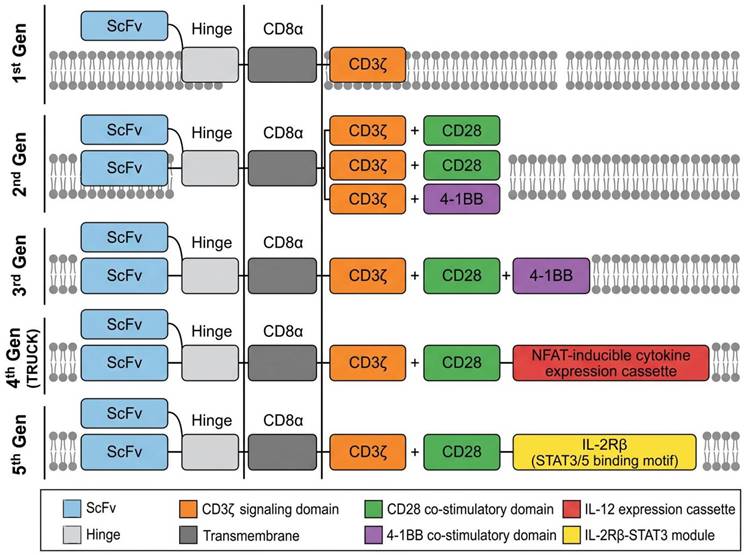
The development of second-generation CAR platforms represented a landmark technical breakthrough, resolving the critical limitation of incomplete T cell activation observed in first-generation constructs [49]. Two distinct second-generation CAR platforms (CD28 vs 4-1BB backbone) now form the backbone of all seven FDA-approved CAR-T agents, with 3-5 year long-term registrational follow-up data revealing consistent functional disparities across patient cohorts [20,50]. CD28-containing CAR-T (axi-cel, ZUMA-1 trial) drives rapid effector T cell proliferation, yielding an 82% objective response rate (ORR) in relapsed DLBCL yet accompanied by 28% grade 3 neurotoxicity at 5-year tracking [20]; by contrast, 4-1BB-based tisa-cel in the ELIANA paediatric B-ALL trial generates central memory-biased T cells, with 63% 3-year overall survival and far lower severe neurotoxicity incidence (13%) [51]. These real-world clinical datasets directly interpret how co-stimulatory domain selection reshapes CAR-T safety and durability in human patients.
The rationale behind third-generation CARs involved the addition of co-stimulatory signals to enhance effectiveness; however, clinical outcomes have not consistently demonstrated superior efficacy when compared to second-generation CARs. Preclinical murine mesothelioma models validated robust tumour clearance for CD28/4-1BB dual-signalling third-generation CARs [52]; nevertheless, the first within-patient head-to-head phase I human trial published in 2026 generated mixed clinical readouts. Although third-generation CARs exhibited higher early peripheral expansion in subjects, no statistically significant improvement in long-term progression-free survival was observed compared to second-generation counterparts, while the risk of high-grade Cytokine Release Syndrome (CRS) was moderately elevated [52]. This direct human comparative trial resolves the discrepancy between promising preclinical performance and ambiguous clinical benefit for multi-costimulatory CAR designs. This observation indicates that simply augmenting signal strength may not be the optimal strategy, but maintaining a balance in T cell functionality and preventing exhaustion could be more crucial than achieving absolute signal intensity [53].
While signal tuning dominated early structural iterations, later CAR generations delivered a fundamental paradigm shift, transforming engineered lymphocytes from simple tumor-killing effectors into multifunctional immune regulatory platforms capable of remodeling the hostile tumor microenvironment. The fourth-generation CAR (TRUCK) represents a significant step forward in design philosophy. It goes beyond the traditional role of CAR-T cells as cytotoxic agents. Instead, it re-engineers them into “bioreactors” that can reconfigure the TME [54]. For example, by utilizing NFAT response elements, CAR recognition of tumor antigens induces IL-12 expression, which reverses the immunosuppressive environment of the TME and recruits macrophages, natural killer (NK) cells, and other immune players to collaborate against the tumor. This is particularly important in addressing the challenge of antigen heterogeneity in solid tumors. The fifth-generation CAR endeavors to integrate the intracellular domains of cytokine receptors (such as IL-2Rβ), with the aim of concurrently receiving antigen-specific signals and cytokine signals, providing a more nuanced integration and amplification of endogenous signals; however, this approach remains in the exploratory phase [55].
3. Innovations and Challenges in Vectors and Transfection Technologies
The clinical translation of CAR-T therapy is significantly dependent on effective and safe gene delivery technologies. An ideal vector system needs to strike a balance among several critical factors, including transfection efficiency, cell viability, risks associated with genomic integration, production costs, and adherence to clinical regulations. In recent years, vector technologies and transfection methods have transitioned from a predominantly viral vector-based approach to a more diverse range that encompasses viral systems, non-viral systems, and emerging in vivo programming techniques. Notably, advancements in in vivo delivery technologies are driving the transformation of CAR-T therapy from “factory-based manufacturing” to “in situ reprogramming” [29,57]. This shift seeks to address key challenges of traditional therapies, including long treatment cycles, high costs, and limited accessibility [58].
3.1 Innovations in Vector Technology
Vectors serve as “vehicles” for CAR genes, with their design directly impacting delivery efficiency and safety. They are broadly categorized into viral and non-viral types (Table 3). While lentivirus and γ-retroviruses dominate current approved CAR products, a wave of non-viral delivery systems have matured over the past two years to address viral vector-associated cost and safety drawbacks, with transposon and lipid nanoparticle systems standing out as the most translationally promising candidates [34,59].
Comparison of CAR-T Vector Technologies
| Category | Specific Vector Platform | Mechanism of Action | Advantages | Disadvantages & Challenges |
|---|---|---|---|---|
| Viral Vectors | Lentivirus (LV) [60,71] | Infects dividing and non-dividing cells. Its RNA genome is reverse-transcribed into DNA and randomly integrated into the host genome, enabling long-term transgene expression. | • High Transduction Efficiency: Highly effective for gene delivery into primary human T cells. • Stable Long-term Expression: Genomic integration ensures CAR persistence, which is critical for durable clinical responses. • Clinically Validated: The current gold standard for most approved ex vivo CAR-T therapies. | • Risk of Insertional Mutagenesis: Random integration poses a theoretical risk of oncogene activation (prompting an FDA black box warning). • Complex and Costly good manufacturing practice (GMP) Manufacturing: Production is time-consuming and expensive. • Immunogenicity: Pre-existing or developed immunity can neutralize the virus. |
| Viral Vectors | γ-Retrovirus [61,62] | Infects primarily dividing cells. Its RNA genome is reverse-transcribed and randomly integrated into the host chromosome. | • Stable Long-term Expression: Proven ability to generate persistent CAR-T cells. • Historical Precedent: Used in foundational CAR-T clinical trials. | • Higher Risk of Insertional Mutagenesis: Greater propensity for integration near gene promoters compared to LV. • Limited to Dividing Cells: Requires pre-activation/expansion of T cells before transduction. • Largely Superseded by lentivirus in modern clinical development. |
| Viral Vectors | Adeno-Associated Virus (AAV) [63] | Infects non-dividing cells. Its single-stranded DNA genome resides predominantly as non-integrated nuclear episomes, supporting sustained intracellular transgene expression that diminishes gradually over time. | • Excellent In Vivo Delivery: Well-established platform for efficient in vivo gene delivery to tissues. • Favorable Safety Profile: Low pathogenicity and primarily non-integrating. | • Small Cargo Capacity (~4.7 kb), often too small for complex CAR constructs. • High Prevalence of Pre-existing Immunity: Neutralizing antibodies in a large population can inactivate the vector. • Not Ideal for Ex Vivo CAR-T: Primarily explored for in vivo delivery due to cost and immunogenicity hurdles. |
| Non-Viral Vectors | Plasmid DNA [64] | Circular DNA vectors are delivered into the cell nucleus via electroporation. The plasmid persists as a non-integrating episome, with expression diluted through cell division. | • Simple and Inexpensive Production: Easy to design and manufacture at scale. • Predominantly episomal with negligible genomic integration potential; rare random integration events cannot be fully ruled out. • Large Cargo Capacity. | • Very Low Transfection Efficiency: Highly inefficient in primary T cells. • Transient and Unstable Expression: The plasmid is easily lost, making it unsuitable for lasting therapies. • High Cytotoxicity: The required electroporation severely impacts T cell fitness and viability. |
| Non-Viral Vectors | mRNA [65] | Synthetic mRNA is delivered directly into the cell cytoplasm (via electroporation or nanoparticles) and is translated into protein without nuclear entry or genomic integration. | • High Safety Profile: No risk of insertional mutagenesis; expression is transient (days), allowing for toxicity management. • Rapid Protein Production: CAR expression begins within hours. • Simpler and Cheaper Manufacturing: Avoids the complexities of viral vector production. | • Transient Expression: Requires repeated administrations for sustained antitumor activity. • Cytotoxicity and Immunogenicity: Electroporation reduces cell fitness; mRNA can activate innate immune pathways. |
| Non-Viral Vectors | Transposon Systems (e.g., Sleeping Beauty, PiggyBac) [64,66, 67,68] | A DNA plasmid containing the CAR gene flanked by transposon sequences is co-delivered with transposase mRNA/protein. The transposase facilitates “cut-and-paste” genomic integration of the transgene. Modern hyper-engineered transposase variants include SB100X (Sleeping Beauty), hyPBase (PiggyBac), and BZ-series mutants derived from the zebrafish-origin ZB transposon (Tc1/mariner superfamily); these variants greatly improve transposition efficiency and support tunable transgene copy-number regulation | • Non-Viral Integration: Enables stable, long-term CAR expression without using a virus. • Lower Manufacturing Cost: Simpler and more scalable GMP production than viral systems. • Large Cargo Capacity. • Greatly improved integration performance enabled by recently optimized hyper-active transposase orthologs | • Variable Integration Efficiency: Often lower than viral transduction, though substantially elevated by hyper-active transposase engineering. • Residual Mutagenesis Risk: Integration is not perfectly targeted, though profiles may be safer than random viral integration. • Technical Complexity: Requires optimization of DNA and transposase delivery. |
| Non-Viral Vectors | Targeted Lipid Nanoparticles (tLNP) [69] | Synthetic nanoparticles encapsulating CAR-encoding mRNA or DNA. The LNP surface is functionalized with targeting ligands (e.g., antibodies) to direct it to specific cell types (e.g., T cells) following systemic intravenous infusion. | • In Vivo CAR-T Generation: Aims to transform CAR-T therapy from a cell product into an injectable “gene drug.” • Targeted Delivery: Reduces off-target effects and improves specificity. • High Safety Potential (with mRNA): Combines the safety of transient expression with targeted delivery. | • Nascent Technology: Still in early-stage clinical trials; human efficacy is not yet fully established. • Delivery Challenges: Achieving high specificity and efficiency in delivering to the correct T-cell subset in vivo is a major hurdle. • Immune Activation: LNPs and their payload can trigger innate immune responses. |
CAR-T: chimeric antigen receptor T-cell.
Viral vectors, particularly lentiviral vectors, continue to be the primary delivery tools for current clinical CAR-T products. These vectors achieve efficient infection through modifications to the viral envelope (for instance, by utilizing vesicular stomatitis virus glycoprotein (VSV-G)). However, their random integration characteristics present a potential risk for insertional mutations [70]. To mitigate this issue, next-generation engineered lentiviral vectors are focusing on “targeted” modifications, such as altering the viral envelope to specifically recognize T cell surface antigens (like CD3), thereby reducing the risk of off-target effects [71]. Beyond envelope modification, multi-layer backbone and integration optimizations further improve vector safety and manufacturability: fourth-generation TetraVecta lentiviral backbones delete redundant accessory genes to suppress innate immune responses during good manufacturing practice (GMP) culture [56]; capsid engineering via peptide libraries and glycan remodeling resolves prevalent human anti-AAV neutralizing antibodies [72]; CRISPR-directed CAR insertion at TRAC/PDCD1 safe harbors fundamentally eliminates oncogenic integration near proto-oncogenes [73].
To bypass the persistent genotoxic and manufacturing burdens of viral platforms, researchers have vigorously advanced non-viral delivery systems with integration-free safety profiles, among which LNPs stand out as the most translationally mature candidate. LNPs play a central role in mRNA delivery, capitalizing on the advancements in mRNA vaccine technology and showcasing strong clinical translation potential [71]. For example, Capstan Therapeutics employs targeted LNPs (tLNPs) to deliver CD19 CAR mRNA directly to CD8+ T cells in vivo for the treatment of autoimmune diseases [70]. Plasmid DNA, the simplest form of gene delivery, still retains its value in basic research and preclinical tool development; However, due to its lower transfection efficiency and challenges with stable integration, it is likely to be gradually supplanted by more efficient technologies in clinical applications [56,72,73]. Recent GMP-ready transposon platforms have advanced to early-phase human trials: Sleeping Beauty-based TranspoCART19 equipped with iCasp9 suicide switches is undergoing Phase I assessment for B-cell malignancies, whereas PiggyBac CAR constructs targeting solid tumors deliver simplified, low-cost plasmid manufacturing pipelines. Hybrid LNP-transposon dual delivery systems combining transposase mRNA and CAR plasmids achieve stable genomic integration without viral reagents, and circular mRNA-LNP vehicles outperform linear mRNA in prolonging CAR expression and alleviating type I interferon immune stimulation. Notably, advances in protein engineering have yielded multiple hyper-active transposase variants: SB100X for Sleeping Beauty, hyPBase for PiggyBac, and BZ-series mutants engineered from the zebrafish-derived ZB transposon (Tc1/mariner superfamily). These protein-optimized enzymes substantially raise transposition efficiency and permit tighter tuning of transgene copy number, accelerating the clinical translation of transposon-derived CAR-T products [66,67,68].
3.2 Diverse Development of Transfection Technology
Transfection technology refers to the methods used to introduce exogenous genes into cells, which can be classified into chemical methods, physical methods, and biological methods (such as viral transduction). The selection of the appropriate method should consider factors such as the type of cells involved, the specific objectives of the experiment, and the context of clinical applications [74]. The traditional in vitro transfection techniques have been continuously refined, with electroporation still serving as a commonly employed method for the transfection of primary T cells.
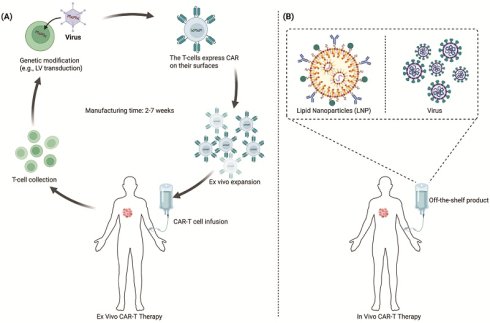
While incremental improvements have been made to ex vivo electroporation and viral transduction pipelines, their inherent drawbacks including mandatory leukapheresis and weeks-long manufacturing cycles severely limit widespread clinical deployment, thereby catalyzing the disruptive innovation of in vivo CAR reprogramming platforms [71]. This innovative approach focuses on the direct delivery of CAR gene vectors (such as lipid nanoparticles or viral vectors) into the patient's body via systemic administration methods, such as intravenous injection, facilitating the generation of CARs within T cells in vivo and eliminating the need for all external manipulation steps (Table 4) [75]. As a preliminary human exploration of such mRNA-LNP in vivo CAR platforms, a 2025 clinical research report published in New England Journal of Medicine described a single-arm exploratory trial applying mRNA-LNP-based in vivo CD19 CAR-T for refractory systemic lupus erythematosus (SLE), enrolling only 5 patients [76]. This trial captured transient CAR expression in circulating T cells and provided preliminary evidence of acceptable short-term safety profiles. However, definitive therapeutic efficacy and long-term safety remain unsubstantiated due to the extremely limited sample size. Larger, randomized controlled phase III trials with extended follow-up are still required to confirm the clinical value of this in vivo CAR strategy for SLE treatment.
Comparison of Ex Vivo and In Vivo CAR-T Cell Therapy Manufacturing Strategies [77].
| Feature | Ex Vivo CAR-T Therapy (Conventional) | In Vivo CAR-T Therapy (Emerging) |
|---|---|---|
| Core Principle & Manufacturing Site | T cells are collected from the patient via leukapheresis, genetically modified, and expanded outside the body (in a centralized GMP facility) before being reinfused. | Genetic instructions for the CAR are delivered directly to the patient's T cells inside the body via an injectable vector. |
| Cell Sourcing & Logistics | Autologous: Relies on the patient's own cells. Requires complex cold chain logistics for transporting cells to and from the manufacturing facility. | Uses the body's endogenous T cells. Eliminates the need for cell extraction and transport, simplifying logistics. |
| Genetic Delivery Vector | Primarily uses viral vectors (e.g., lentivirus) for stable genomic integration of the CAR gene in the lab. | Uses viral vectors (lentivirus) or non-viral vectors like targeted LNPs carrying mRNA or other nucleic acid payloads. |
| Vein-to-Vein Time & Readiness | Lengthy process (2-7 weeks), leading to a significant waiting period. Not an off-the-shelf product. | Rapid administration. Aims for “on-demand” treatment. Designed as an off-the-shelf, readily available product. |
| Patient Preconditioning | Requires lymphodepleting chemotherapy (e.g., fludarabine/cyclophosphamide) prior to infusion to enhance engraftment. | Potentially eliminates the need for lymphodepletion, as it does not require making “space” for externally expanded cells. |
| Cost Structure | Extremely high (approx. $500,000 per dose) due to personalized, complex manufacturing and quality control. [34] | The elimination of patient-specific ex vivo cell manufacturing provides broad theoretical potential to drastically cut overall therapeutic expenditures; multiple reviews predict substantial long-term cost savings compared to current autologous CAR-T platforms. |
| Persistence of CAR-T Cells | Long-lasting or permanent due to genomic integration by viral vectors, aiming for durable remission. | Can be transient (especially with mRNA/LNP platforms, lasting days) or persistent (with integrating viral vectors), allowing for dose-tunable activity. |
| Key Advantages | Established, proven efficacy in hematologic malignancies; controlled manufacturing process. | Simplified administration, lower cost potential, broader accessibility, faster treatment initiation, potential for improved safety profile. |
| Major Challenges | High cost, complex logistics, long manufacturing time, need for specialized centers, risk of severe toxicities (CRS, ICANS). | Targeting specificity (ensuring CAR gene is delivered only to intended T cells), managing immune responses to the vector, optimizing efficiency, and long-term safety concerns like insertional mutagenesis (for viral vectors). |
| Representative Companies/Developers | Novartis, Gilead, Bristol Myers Squibb, Johnson & Johnson. | Capstan Therapeutics, EsoBiotec (acquired by AstraZeneca), Umoja Biopharma. |
| Clinical Stage | Approved and commercially available for several hematologic cancers. | Early-stage clinical trials (Phase I). Primarily in preclinical and discovery phases for many assets. |
CAR-T: chimeric antigen receptor T-cell; CRS: cytokine release syndrome; ICANS: immune effector cell-associated neurotoxicity syndrome.
3.3 Breakthroughs and Challenges in In Vivo Programming
In vivo CAR-T generation technology is currently at the cutting edge, aiming to directly reprogram T cells within patients through a single injection of a gene delivery vector, enabling them to express CAR [57]. The central challenge lies in achieving efficient and specific in vivo targeted delivery.
LNP-mRNA Pathway: This pathway delivers CAR mRNA by designing LNPs that specifically target T cells (for example, using surface-conjugated anti-CD8 antibodies). Its primary advantage is high safety, as the mRNA is only expressed transiently in the cytoplasm, does not integrate into the genome, and has controllable side effects [29,78,79,80]. For instance, if adverse reactions occur, CAR proteins can be rapidly cleared after medication is discontinued. This 2025 NEJM Phase I cohort enrolled five heavily pretreated refractory lupus patients treated without prior lymphodepletion chemotherapy and achieved rapid peripheral B cell depletion. Nevertheless, mRNA-mediated CAR expression only lasts 7-10 days and results in gradual autoreactive B cell recovery. Preclinical CD5-targeted LNPs loaded with FAP CAR mRNA expand the therapeutic scope to fibrotic diseases, while Capstan and Interius' in vivo LNP programs have entered Phase I trials; systemic hepatic sequestration and inconsistent endogenous T cell counts remain core translational barriers.
Beyond targeting-efficiency bottlenecks, in-vivo CAR-T systems carry unique safety risks that do not exist for conventional ex-vivo-manufactured CAR-T products [75]. Systemically infused delivery vehicles (tLNPs or targeted viral vectors) may produce off-target transfection of non-T-cell populations, including myeloid cells and hepatocytes, which could drive aberrant CAR expression in unintended cell types and trigger unforeseen local inflammation or antigen-directed cytotoxicity [77]. For LNP-based platforms, prominent hepatic sequestration represents a well-documented translational risk; substantial fractions of administered nanoparticles are scavenged by liver-resident macrophages, potentially elevating liver enzyme levels and innate immune cascades upon repeated dosing [79]. Multiple complementary mitigation approaches are being actively investigated to reduce these hazards. First, surface engineering of delivery carriers (incorporating anti-CD3/CD8 targeting moieties, fusogen modification for viral vectors) improves T-cell-selective tropism and reduces uptake by off-target cell subsets. Second, employing non-integrating mRNA payloads delivers only transient CAR expression; even if off-target transfection occurs, CAR protein will degrade within days without genomic modification, limiting persistent adverse consequences. Third, orthogonal safety-control modules such as inducible suicide switches (e.g., iCasp9) or small-molecule-regulated ON/OFF CAR circuits can be co-incorporated into vector constructs, enabling rapid, pharmacologic ablation of CAR-bearing cells should toxic manifestations emerge [75]. Even with these safeguards, thorough pre-clinical biodistribution profiling and careful monitoring of liver function, cytokine levels, and off-tissue CAR-positive cell populations remain mandatory for early-phase clinical trials of systemically administered in-vivo CAR-T therapeutics.
However, in vivo programming technology still encounters several significant challenges. These challenges include bottlenecks in targeting precision and efficiency, as ensuring that the vector only infects the intended T cell subpopulation without damaging other cells is fundamental to safety. A key technical barrier is how to effectively concentrate the systemically administered vector in the target T cells, rather than having it captured by the liver or other tissues [81]. Additionally, individual variability poses a major challenge, as there are significant differences in both the quantity and condition of T cells among patients, making it difficult to establish a universal dosing regimen.
4. Challenges in CAR-T Technology
Despite the significant achievements of CAR-T therapy in the treatment of hematologic malignancies, its further development and widespread application still face multiple severe challenges, primarily in three areas: safety, effectiveness in treating solid tumors, and production processes and accessibility [31,82].
4.1 Safety Challenges: Toxic Side Effects and Management
CAR-T cell therapy presents significant safety risks due to excessive activation and nonspecific killing of cells, primarily manifesting as CRS and Immune Effector Cell-Associated Neurotoxicity Syndrome (ICANS) [83]. The underlying mechanism involves the recognition of target antigens by CAR-T cells, which leads to their massive proliferation and the release of inflammatory cytokines (such as IL-6 and IFN-γ) [84]. These responses can cause severe symptoms such as high fever, hypotension, and hypoxia, which may be life-threatening. Additionally, neurotoxicity may present as confusion, dysphasia, or cerebral edema. Tocilizumab (an anti-IL-6 receptor antibody) and corticosteroids are currently the first-line therapies used to treat CRS [85]. A more profound concern is the potential risk of secondary T-cell malignancies. The U.S. FDA has issued black box warnings for all marketed BCMA- and CD19-targeted CAR-T products to flag a potential correlative link to secondary T-cell malignancies, yet the exact causative pathways remain incompletely defined. Random genomic integration of lentiviral vectors is a widely hypothesized contributing mechanism, as vector insertion near endogenous proto-oncogenes may theoretically drive oncogene overexpression; however, this integration event cannot be confirmed as the sole definitive causal factor, with multiple pre-existing patient clonal hematopoiesis and prior chemotherapy co-variables jointly implicated [86]. According to 2024 FAERS pharmacovigilance database analysis, secondary T-cell malignancy case submissions account for approximately 0.1% of all CAR-T-associated adverse event records submitted to the FDA. Despite the low proportional volume of these adverse event submissions, long-term longitudinal safety follow-up remains mandatory for all CAR-T recipients per FDA regulatory guidance to monitor rare late-onset oncogenic complications [87].
Additionally, off-target and off-tumor toxicity pose significant issues, as CAR-T cells may attack healthy organs when the target antigen is expressed at low levels on normal tissues. To address these risks, innovative safety strategies are actively being explored, such as inducible suicide genes (like the iCasp9 system) and logic-gated designs (such as AND-gate CAR-T).
4.2 Multiple Barriers to the Treatment of Solid Tumors
Hematological malignancies and solid tumours exhibit drastically divergent biological landscapes that generate stark discrepancies in CAR-T clinical outcomes. A pooled systematic analysis of phase I/II clinical data spanning the past five years reveals a pronounced therapeutic dichotomy: CD19/BCMA-targeted CAR-T yields objective response rates (ORRs ranging 70%-90%) with sustained complete remission in relapsed B-cell neoplasms, while solid tumour CAR trials rarely achieve ORRs exceeding 10%-20%, with most clinical benefits limited to transient disease stabilization rather than curative tumour eradication [88,89]. Table 5 systematically quantifies and contrasts core clinical and biological disparities between the two tumour categories.
Systematic Comparison of CAR-T Efficacy: Hematological Malignancies vs. Solid Tumors [89,90].
| Clinical / Biological Parameter | Hematological Malignancies (e.g., B-ALL, LBCL, MM) | Solid Tumors (e.g., Glioblastoma, Pancreatic, Gastric Cancers) |
|---|---|---|
| Objective Response Rate (ORR) | Exceptionally high (70% - 90%), frequently leading to complete, durable remission. | Generally low (<20%), with clinical benefits mostly limited to transient stable disease. |
| Antigen Expression Profile | Highly homogeneous and lineage-specific (e.g., CD19 is universally expressed on all B cells). | Extremely heterogeneous; antigen-negative or low-expressing tumor variants frequently drive immune escape. |
| Trafficking and Infiltration | Excellent access via systemic blood circulation and highly permissive lymphatic tissues. | Severely restricted by highly abnormal tumor vasculature and dense, fibrotic extracellular matrix (ECM). |
| Tumor Microenvironment (TME) | Relatively permissive to immune effector functions. | Deeply immunosuppressive; characterized by high concentrations of TGF-β, Tregs, tumor-associated macrophages (TAMs), and myeloid-derived suppressor cells (MDSCs). |
| CAR-T Activation and Longevity | High activation efficiency; potential for years-long central memory persistence. | Rapid metabolic exhaustion driven by chronic, relentless antigen exposure and extreme nutrient starvation (hypoxia). |
To overcome these interconnected, multifaceted solid tumour barriers, layered engineered and combinatorial therapeutic strategies validated by abundant preclinical and early human trial datasets have been developed [28,44]. First, to address antigen heterogeneity, dual- or multi-target CAR designs (e.g., targeting both EGFRvIII and IL13Rα2 in glioblastoma, or Claudin18.2 and MUC1 in gastric cancer) are utilized to prevent immune escape driven by antigen shedding or natural downregulation. [88,91,92]. Second, intrinsic T cell functional enhancement is achieved by engineering CAR-T cells to co-express extracellular matrix (ECM)-degrading enzymes, such as heparanase, enabling the cells to physically drill through the fibrotic stroma to reach the tumor core. Finally, combinatorial therapeutic regimens are widely considered paramount for solid tumor success; co-administering CAR-T cells with immune checkpoint inhibitors (e.g., anti-PD-1 or anti-PD-L1 monoclonal antibodies) serves to block the terminal inhibitory pathways that trigger T cell exhaustion immediately upon entry into the highly suppressive TME [28,93,94,95].
4.3 Manufacturing, Quality Control, and Economic Translation Challenges
The complex individualized manufacturing workflow, stringent global regulatory quality control standards, and prohibitive production costs collectively constitute a core category of clinical translational barriers for CAR-T therapeutics. Autologous CAR-T relies on patient-derived lymphocytes for one-off bespoke production, a characteristic that creates inherent batch variability, long treatment waiting periods and severe accessibility disparities worldwide [96]. The complete vein-to-vein manufacturing pipeline consists of sequential leukapheresis for T cell collection, cryopreserved cold-chain transportation to centralized GMP facilities, T cell enrichment and activation, viral vector-mediated genetic transduction, bioreactor expansion, multi-layer quality control release testing, and final shipment back to clinical wards for patient infusion, with a standard production cycle spanning 3-6 weeks per individual patient product [97]. This lengthy workflow often leads to disease progression in late-stage tumour candidates before CAR-T preparation is completed, disqualifying many patients from receiving curative cell therapy.
Unlike small-molecule or antibody drugs with unified industrial production lines, CAR-T as a living cellular medicinal product requires highly rigorous lot release testing defined as critical quality attributes (CQAs) under FDA and EMA regulatory frameworks. Conventional pharmaceutical detection systems are often insufficient to evaluate its safety and functional activity. Four core mandatory quality control (QC) testing modules are enforced for final batch approval before clinical infusion [98,99]:
1. Microbial safety and viral risk verification: Each finished product undergoes comprehensive sterility testing, mycoplasma and endotoxin quantification, alongside high-sensitivity molecular detection to eliminate replication-competent lentivirus (RCL) or retrovirus contaminants that carry life-threatening insertional mutagenesis risks.
2. Cell identity and purity profiling: High-parameter flow cytometry confirms a high proportion of CD3+ T cells (e.g., ≥90%), balanced CD4/CD8 subset ratios, and removal of residual malignant tumor cells and magnetic activation microbead impurities.
3. Functional potency quantification: Calibrated co-culture cytotoxicity assays measure specific tumor lysis capacity and antigen-triggered secretion of effector cytokines (e.g., IFN-γ and TNF-α), serving as a core readout of in vivo therapeutic potential.
4. Genomic stability assessment: qPCR vector copy number (VCN) detection is used to ensure a limited number of integrated vector copies per T cell (e.g., fewer than 4-5), balancing sufficient CAR surface expression with the risk of oncogenic gene insertion. All QC assays must be completed within a narrow post-expansion time window, as live CAR-T cells cannot be stably cryopreserved for repeated retesting.
The culmination of these bespoke manufacturing steps, highly skilled labor requirements, and exhaustive QC assays drives the cost of ex vivo CAR-T therapy to extraordinary, highly prohibitive heights. In Western markets, baseline commercial costs generally range from $373,000 to over $500,000 per dose, completely excluding the ancillary costs of hospitalization, critical care for toxicity management, and long-term follow-up [100]. This economic reality restricts access primarily to elite healthcare systems in high-income countries.
To counteract this profound global health inequality, alternative manufacturing and economic paradigms are being aggressively explored. An emergent, highly successful strategy involves localizing production in emerging markets or utilizing decentralized, point-of-care manufacturing at specific academic hospitals. A landmark achievement in this arena occurred recently when India approved its first indigenous CAR-T product, NexCAR19 (actalycel) [101]. Developed through a collaboration between ImmunoACT, the Indian Institute of Technology (IIT) Bombay, and Tata Memorial Hospital, NexCAR19 was engineered specifically for resource-constrained environments. By establishing independent, domestic viral vector manufacturing and streamlining the entire supply chain through a hub-and-spoke model, the total cost of NexCAR19 was reduced to approximately $30,000 to $50,000. This represents a staggering 10-fold reduction compared to standard global pricing models, unequivocally demonstrating that localized biomedical innovation and academic-industry partnerships can drastically improve global patient accessibility to advanced cellular therapies.
5. Future Development Trends and Innovative Directions
To overcome the aforementioned bottlenecks, CAR-T technology is rapidly evolving toward safer, more efficient, and more accessible solutions, giving rise to several promising innovative directions.
Universal CAR-T, also known as “off-the-shelf” CAR-T, aims to utilize T cells from healthy donors for large-scale, standardized production, creating readily available “off-the-shelf” products [102]. The core technology involves employing gene editing techniques (such as CRISPR/Cas9) to knock out the T cell receptor (TCR) and HLA class I molecules in donor T cells, thereby avoiding graft-versus-host disease (GvHD) and host immune rejection [103]. Although challenges remain regarding in vivo persistence, universal CAR-T holds the potential to significantly reduce costs and preparation timelines, making it a key pathway to address accessibility issues [102]. Several companies, including Cellectis and Allogene, are actively investing in this area.
In Vivo CAR-T generation technology represents one of the most disruptive frontiers, aiming to achieve “in situ reprogramming” by intravenously delivering a targeted delivery system (such as lipid nanoparticles or viral vectors) that directly introduces the gene encoding CAR (DNA or mRNA) into the patient's T cells. This technology eliminates all steps of ex vivo manufacturing, transforming CAR-T therapy from a “cell product” into a “gene therapy,” thereby greatly simplifying the process and reducing costs [57]. A groundbreaking 2025 study demonstrated that in vivo generation of transient FAP-targeting CAR-T cells can be achieved through a single intravenous injection of CD5 antibody-directed LNPs encapsulating CAR mRNA. This approach successfully reversed established pulmonary fibrosis and promoted lung regeneration in mouse models, highlighting the platform's immense therapeutic potential for treating fibrotic diseases [104]. Companies such as Capstan Therapeutics and Interius BioTherapeutics are benchmark enterprises in this field, and their INT2104 and CPTX-2309 clinical programs are actively exploring the clinical application of this technology [75].
To enhance safety and combat solid tumors, the next generation of CAR-T designs focuses on “intelligence” and functional integration. This includes: Logic-gated systems, such as AND and NOT gates, which require multiple conditions to be met for CAR-T cell activation, allowing precise differentiation between tumor and normal tissues [35,105]. Armored CAR-T: By co-expressing cytokines (such as IL-12, IL-15) or chemokines, this design modifies and reshapes the immunosuppressive tumor microenvironment, enhancing CAR-T cell functionality and recruiting endogenous immune cells [106]. Tunable systems: Introducing “molecular switches” that can be controlled by small molecules (such as rapamycin or tetracycline) enables real-time precise regulation of CAR-T cell activity [107].
Beyond CD19 and BCMA, researchers are actively developing new targets for solid tumors—such as Claudin18.2, GPC3, and B7-H3—as well as dual- and multi-target CAR-T therapies, such as CD19/CD22, to address antigen escape and heterogeneity [91,92]. The combination of CAR-T with other therapies demonstrates synergistic potential. For instance, combining with immune checkpoint inhibitors (such as PD-1/PD-L1 antibodies) can reverse T cell exhaustion [94]; combining with oncolytic viruses can degrade solid tumor barriers and amplify antitumor effects [95]; and combining with targeted therapies or radiotherapy can enhance antigen release and immune responses [108].
6. Conclusion
CAR-T cell therapy is experiencing a profound technological transformation. In the next five to ten years, collaborative innovations in areas such as universal technology, in vivo programming, and intelligent design are expected to significantly improve the safety, efficacy, and accessibility of CAR-T therapy. This progress will transform CAR-T therapy from a highly customized “elite therapy” into a safer, more effective, and affordable treatment accessible to a wider range of cancer patients and individuals with autoimmune diseases.
Abbreviations
AAV: adeno-associated virus; CAIX: carbonic anhydrase IX; CAR: chimeric antigen receptor; CAR-T: chimeric antigen receptor T-cell; CQAs: critical quality attributes; CRS: cytokine release syndrome; ECM: extracellular matrix; FDA: United States Food and Drug Administration; EMA: European Medicines Agency; GvHD: graft-versus-host disease; GMP: good manufacturing practice; ICANS: immune effector cell-associated neurotoxicity syndrome; LV: lentivirus; MDSC: myeloid-derived suppressor cells; MHC: major histocompatibility complex; NK: natural killer; ScFv: single-chain variable fragment; SLE: systemic lupus erythematosus; TAM: tumor-associated macrophages; TCR: T cell receptor; TME: tumor microenvironment; Treg: regulatory T cell; VCN: vector copy number; VSV-G: vesicular stomatitis virus glycoprotein; VH: variable heavy chain; VL: variable light chain; CD28: cluster of differentiation 28; CD3ζ: cluster of differentiation 3 zeta subunit; CD19: cluster of differentiation 19; BCMA: B-cell maturation antigen.
Acknowledgements
This research was funded with the Shanghai Science and Technology Innovation Action Plan, Cell and Gene Therapy Project, Science and Technology Commission of Shanghai Municipality (23J21900500). The authors acknowledge Shanghai University, Shanghai Mengchao Cancer Center Hospital, Shanghai Cell Therapy Group Corporation, Shanghai Genefine Biotechnology Corporation, and International Longevity Medicine Research Institute for their invaluable support and collaboration throughout this research.
Data Availability
All data, analytical frameworks, and structural comparative analyses synthesized and discussed within this manuscript are sourced entirely from publicly accessible peer-reviewed literature, global clinical trial registries, and official regulatory databases (FDA, EMA). No original primary datasets were generated during the composition of this comprehensive review. Specific data points regarding clinical trials, product approvals, health economics, and adverse event incidence rates can be directly accessed via the cited pharmacovigilance reports and published literature identifiers provided throughout the text.
Competing Interests
The authors have declared that no competing interest exists.
References
1. Eshhar Z, Waks T, Gross G. et al. Specific activation and targeting of cytotoxic lymphocytes through chimeric single chains consisting of antibody-binding domains and the gamma or zeta subunits of the immunoglobulin and T-cell receptors. Proc Natl Acad Sci USA. 1993;90:720-4
2. Shiina S, Ohno M, Ohka F. et al. CAR T cells targeting podoplanin reduce orthotopic glioblastomas in mouse brains. Cancer Immunol Res. 2016;4:259-68
3. Gross G, Waks T, Eshhar Z. Expression of immunoglobulin-T-cell receptor chimeric molecules as functional receptors with antibody-type specificity. Proc Natl Acad Sci USA. 1989;86:10024-8
4. Chmielewski M, Hombach AA, Abken H. Antigen-specific T-cell activation independently of the MHC: chimeric antigen receptor-redirected T cells. Front Immunol. 2013;4:371
5. Rafei H, Upadhyay R, Sharma P. A guide to CAR T cell therapies: development, current status and future prospects. Nat Rev Immunol. Published online July 2. 2026
6. Munshi NC, Anderson LD, Shah N. et al. Idecabtagene vicleucel in relapsed and refractory multiple myeloma. New England Journal of Medicine. 2021;384(8):705-716
7. Rodriguez-Otero P, Ailawadhi S, Arnulf B. et al. Ide-cel or standard regimens in relapsed and refractory multiple myeloma. New England Journal of Medicine. 2023;388(11):1002-1014
8. Roddie C, Sandhu KS, Tholouli E. et al. Obecabtagene Autoleucel in adults with B-Cell acute lymphoblastic leukemia. New England Journal of Medicine. 2024;391(23):2219-2230
9. Kamdar M, Solomon SR, Arnason J. et al. Lisocabtagene maraleucel versus standard of care with salvage chemotherapy followed by autologous stem cell transplantation as second-line treatment in patients with relapsed or refractory large B-cell lymphoma (TRANSFORM): results from an interim analysis of an open-label, randomised, phase 3 trial. The Lancet. 2022;399(10343):2294-2308
10. Morschhauser F, Dahiya S, Palomba ML. et al. Lisocabtagene maraleucel in follicular lymphoma: the phase 2 TRANSCEND FL study. Nat Med. 2024;30(8):2199-2207
11. Palomba ML, Schuster SJ, Karmali R. et al. Lisocabtagene maraleucel in patients with relapsed or refractory marginal zone lymphoma (TRANSCEND FL): primary analysis results from the global, multicohort, single-arm, phase 2 study. The Lancet. 2026;407(10532):963-975
12. Berdeja JG, Madduri D, Usmani SZ. et al. Ciltacabtagene autoleucel, a B-cell maturation antigen-directed chimeric antigen receptor T-cell therapy in patients with relapsed or refractory multiple myeloma (CARTITUDE-1): a phase 1b/2 open-label study. The Lancet. 2021;398(10297):314-324
13. Jagannath S, Martin TG, Lin Y. et al. Long-term (≥5-Year) remission and survival after treatment with ciltacabtagene autoleucel in CARTITUDE-1 patients with relapsed/refractory multiple myeloma. J Clin Oncol. 2025;43(25):2766-2771
14. Maude SL, Laetsch TW, Buechner J. et al. Tisagenlecleucel in children and young adults with B-Cell lymphoblastic leukemia. New England Journal of Medicine. 2018;378(5):439-448
15. Schuster SJ, Bishop MR, Tam CS. et al. Tisagenlecleucel in adult relapsed or refractory diffuse large B-cell lymphoma. New England Journal of Medicine. 2019;380(1):45-56
16. Fowler NH, Dickinson M, Dreyling M. et al. Tisagenlecleucel in adult relapsed or refractory follicular lymphoma: the phase 2 ELARA trial. Nat Med. 2022;28(2):325-332
17. Wang M, Munoz J, Goy A. et al. KTE-X19 CAR T-Cell Therapy in relapsed or refractory mantle-cell lymphoma. New England Journal of Medicine. 2020;382(14):1331-1342
18. Shah BD, Ghobadi A, Oluwole OO. et al. KTE-X19 for relapsed or refractory adult B-cell acute lymphoblastic leukaemia: phase 2 results of the single-arm, open-label, multicentre ZUMA-3 study. The Lancet. 2021;398(10299):491-502
19. Neelapu SS, Locke FL, Bartlett NL. et al. Axicabtagene ciloleucel CAR T-cell therapy in refractory large B-cell lymphoma. New England Journal of Medicine. 2017;377(26):2531-2544
20. Neelapu SS, Jacobson CA, Ghobadi A. et al. Five-year follow-up of ZUMA-1 supports the curative potential of axicabtagene ciloleucel in refractory large B-cell lymphoma. Blood. 2023;141(19):2307-2315
21. Locke FL, Miklos DB, Jacobson CA. et al. Axicabtagene ciloleucel as second-line therapy for large B-cell lymphoma. New England Journal of Medicine. 2022;386(7):640-654
22. Asari K, Chelvaretnam S, Mom KT. et al. Enhancing chimeric antigen receptor-extracellular vesicles (CAR-EV) technology: the future of cancer therapy. J Vis Exp. 2025
23. Han D, Xu Z, Zhuang Y. et al. Current progress in CAR-T cell therapy for hematological malignancies. J Cancer. 2021;12:326-34
24. June CH, Sadelain M. Chimeric antigen receptor therapy. N Engl J Med. 2018;379:64-73
25. Zhang H, Ye ZL, Yuan ZG. et al. New strategies for the treatment of solid tumors with CAR-T cells. Int J Biol Sci. 2016;12:718-29
26. Balke-Want H, Keerthi V, Cadinanos-Garai A. et al. Non-viral chimeric antigen receptor (CAR) T cells going viral. Immunooncol Technol. 2023;18:100375
27. Martinez M, Moon EK. CAR T cells for solid tumors: new strategies for finding, infiltrating, and surviving in the tumor microenvironment. Front Immunol. 2019;10:128
28. Du B, Qin J, Lin B. et al. CAR-T therapy in solid tumors. Cancer Cell. 2025;43:665-79
29. Rurik JG, Tombácz I, Yadegari A. et al. CAR T cells produced in vivo to treat cardiac injury. Science. 2022;375:91-6
30. Sadeqi Nezhad M. Poly (beta-amino ester) as an in vivo nanocarrier for therapeutic nucleic acids. Biotechnol Bioeng. 2023;120:95-113
31. Sterner RC, Sterner RM. CAR-T cell therapy: current limitations and potential strategies. Blood Cancer J. 2021;11:69
32. Zheng Z, Li S, Liu M. et al. Fine-tuning through generations: advances in structure and production of CAR-T therapy. Cancers (Basel). 2023;15:3476
33. Patel KK, Tariveranmoshabad M, Kadu S. et al. From concept to cure: the evolution of CAR-T cell therapy. Mol Ther. 2025;33:2123-40
34. Pinto E, Lione L, Compagnone M. et al. From ex vivo to in vivo chimeric antigen T cells manufacturing: new horizons for CAR T-cell based therapy. J Transl Med. 2025;23:10
35. Alsaieedi AA, Zaher KA. Tracing the development of CAR-T cell design: from concept to next-generation platforms. Front Immunol. 2025;16:1615212
36. Sela-Culang I, Kunik V, Ofran Y. The structural basis of antibody-antigen recognition. Front Immunol. 2013;4:302
37. Li Z, Cheng Y, Xi H. et al. A novel variable antibody fragment dimerized by leucine zippers with enhanced neutralizing potency against rabies virus G protein compared to its corresponding single-chain variable antibody fragment. Mol Immunol. 2015;68:168-75
38. Tong C, Liang Y, Han X. et al. Research progress of dendritic cell surface receptors and targeting. Biomedicines. 2023;11:1673
39. Fujiwara K, Tsunei A, Kusabuka H. et al. Hinge and transmembrane domains of chimeric antigen receptor regulate receptor expression and signaling threshold. Cells. 2020;9:1182
40. Dwivedi A, Karulkar A, Ghosh S. et al. Lymphocytes in cellular therapy: functional regulation of CAR T cells. Front Immunol. 2018;9:3180
41. Alabanza L, Pegues M, Geldres C. et al. Function of novel anti-CD19 chimeric antigen receptors with human variable regions is affected by hinge and transmembrane domains. Mol Ther. 2017;25:2452-65
42. Long AH, Haso WM, Shern JF. et al. 4-1BB costimulation ameliorates T cell exhaustion induced by tonic signaling of chimeric antigen receptors. Nat Med. 2015;21:581-90
43. Cook MS, King E, Flaherty KR. et al. CAR-T cells containing CD28 versus 4-1BB co-stimulatory domains show distinct metabolic profiles in patients. Cell Rep. 2025;44:115973
44. AlDallal SM. Yescarta: a new era for non-Hodgkin lymphoma patients. Cureus. 2020;12:e11504
45. Smith R, Shen R. Complexities in comparing the impact of costimulatory domains on approved CD19 CAR functionality. J Transl Med. 2023;21:515
46. Keyer V, Kydyrbayeva A, Kulatay T. et al. Introducing CAR-T therapy in Kazakhstan: establishing academic-scale lentiviral vector and CAR-T cell production. Biomolecules. 2025;15:1166
47. Lamers CHJ, Sleijfer S, Vulto AG. et al. Treatment of metastatic renal cell carcinoma with autologous T-lymphocytes genetically retargeted against carbonic anhydrase IX: First clinical experience. J Clin Oncol. 2006;24(13):e20-e22
48. Kershaw MH, Westwood JA, Parker LL. et al. A phase I study on adoptive immunotherapy using gene-modified T cells for ovarian cancer. Clin Cancer Res. 2006;12(20):6106-6115
49. Jackson HJ, Rafiq S, Brentjens RJ. Driving CAR T-cells forward. Nat Rev Clin Oncol. 2016;13:370-83
50. Cappell KM, Kochenderfer JN. Long-term outcomes following CAR T cell therapy: what we know so far. Nat Rev Clin Oncol. 2023;20(6):359-371
51. Grupp SA, Kalos M, Barrett D. et al. Chimeric Antigen Receptor-Modified T Cells for Acute Lymphoid Leukemia. N Engl J Med. 2013;368(16):1509-1518
52. Carpenito C, Milone MC, Hassan R. et al. Control of large, established tumor xenografts with genetically retargeted human T cells containing CD28 and CD137 domains. PNAS. 2009;106(9):3360-3365
53. Wang JY, Wang L. CAR-T cell therapy: where are we now, and where are we heading? Blood Sci. 2023;5:237-48
54. Putignano G, Ruipérez-Campillo S, Yuan Z. et al. Mathematical models and computational approaches in CAR-T therapeutics. Front Immunol. 2025;16:1581210
55. Tokarew N, Ogonek J, Endres S. et al. Teaching an old dog new tricks: next-generation CAR T cells. Br J Cancer. 2019;120:26-37
56. Kuwana Y, Asakura Y, Utsunomiya N. et al. Expression of chimeric receptor composed of immunoglobulin-derived V resions and T-cell receptor-derived C regions. Biochem Biophys Res Commun. 1987;149(3):960-968
57. Hunter TL, Bao Y, Zhang Y. et al. In vivo CAR T cell generation to treat cancer and autoimmune disease. Science. 2025;388:1311-7
58. Labanieh L, Mackall CL. CAR immune cells: design principles, resistance and the next generation. Nature. 2023;614:635-48
59. Zhang Z, Cui D, Wang H, Wu L, Liu X. Unleashing CAR-T potential in solid tumors: overcoming intrinsic and extrinsic hurdles to improve therapy. Cancer Immunol Immunother. 2026;75(2):37
60. Naldini L, Blömer U, Gallay P. et al. In vivo gene delivery and stable transduction of nondividing cells by a lentiviral vector. Science. 1996;272(5259):263-267
61. Hacein-Bey-Abina S, Von Kalle C, Schmidt M. et al. LMO2-associated clonal T cell proliferation in two patients after gene therapy for SCID-X1. Science. 2003;302(5644):415-419
62. Baum C, Schambach A, Bohne J, Galla M. Retrovirus vectors: Toward the plentivirus? molecular therapy. 2006;13(6):1050-1063
63. Naso MF, Tomkowicz B, Perry WL, Strohl WR. Adeno-associated virus (AAV) as a vector for gene therapy. BioDrugs. 2017;31(4):317-334
64. Manuri PVR, Wilson MH, Maiti SN. et al. piggyBac transposon/transposase system to generate CD19-specific T cells for the treatment of B-lineage malignancies. Human Gene Therapy. 2010;21(4):427-437
65. Xiao K, Lai Y, Yuan W. et al. mRNA-based chimeric antigen receptor T cell therapy: Basic principles, recent advances and future directions. Interdisciplinary Medicine. 2024;2(1):e20230036
66. VandenDriessche T, Ivics Z, Izsvák Z, Chuah MKL. Emerging potential of transposons for gene therapy and generation of induced pluripotent stem cells. Blood. 2009;114(8):1461-1468
67. Wu M, Li J, Xu Y. et al. Sequentially conquering transfection obstacles of primary human T cells via non-classical lipid nanoparticles delivering reformative transposon system. Journal of Controlled Release. 2025;383:113779
68. Wang S, Zhang P, Sun Y. et al. Engineering of BZ transposase and transposon donor vector for enhanced efficiency and safety in gene delivery applications. Nucleic Acids Research. 2025;53(18):gkaf935
69. Gao P, Liu J, Ma J, Ma H, Zhang Y. In vivo CAR-T cell therapy: latest updates from 2025 ASH annual meeting. J Hematol Oncol. 2026;19(1):21
70. Oliveira BC, Bari S, Melenhorst JJ. Leveraging vector-based gene disruptions to enhance CAR T-cell effectiveness. Cancers (Basel). 2025;17:383
71. Michels A, Ho N, Buchholz CJ. Precision medicine: in vivo CAR therapy as a showcase for receptor-targeted vector platforms. Mol Ther. 2022;30:2401-15
72. Labbé RP, Vessillier S, Rafiq QA. Lentiviral vectors for T cell engineering: clinical applications, bioprocessing and future perspectives. Viruses. 2021;13:1528
73. Simkhada D, Teo SHC, Deorkar N. et al. Transfection technologies for next-generation therapies. J Clin Med. 2025;14:5515
74. Chong ZX, Yeap SK, Ho WY. Transfection types, methods and strategies: a technical review. PeerJ. 2021;9:e11165
75. Bot A, Scharenberg A, Friedman K. et al. In vivo chimeric antigen receptor (CAR)-T cell therapy. Nat Rev Drug Discov. 2025;25:116-37
76. Wang Q, Xiao ZX, Zheng X. et al. In vivo CD19 CAR T-cell therapy for refractory systemic lupus erythematosus. N Engl J Med. 2025;393:1542-4
77. Li YR, Zhu Y, Halladay T, Yang L. In vivo CAR engineering for immunotherapy. Nat Rev Immunol. 2025;25(10):725-744
78. Billingsley MM, Singh N, Ravikumar P. et al. Ionizable lipid nanoparticle-mediated mRNA delivery for human CAR T cell engineering. Nano Lett. 2020;20:1578-89
79. Billingsley MM, Gong N, Mukalel AJ. et al. In vivo mRNA CAR T cell engineering via targeted ionizable lipid nanoparticles with extrahepatic tropism. Small. 2024;20:e2304378
80. Chen Z, Ren A, Li Y. et al. mRNA-laden lipid nanoparticle-enabled humanized CD19 CAR-T-cell engineering for the eradication of leukaemic cells. Br J Haematol. 2025;206:628-43
81. Li HR, Harb M, Heath JE. et al. Engineering viral vectors for acoustically targeted gene delivery. Nat Commun. 2024;15:4924
82. Zhang G, Bai M, Du H. et al. Current advances and challenges in CAR-T therapy for hematological and solid tumors. Immunotargets Ther. 2025;14:655-80
83. Neelapu SS, Tummala S, Kebriaei P. et al. Chimeric antigen receptor T-cell therapy - assessment and management of toxicities. Nat Rev Clin Oncol. 2018;15:47-62
84. Giavridis T, van der Stegen SJC, Eyquem J. et al. CAR T cell-induced cytokine release syndrome is mediated by macrophages and abated by IL-1 blockade. Nat Med. 2018;24:731-8
85. Lee DW, Santomasso BD, Locke FL. et al. ASTCT consensus grading for cytokine release syndrome and neurologic toxicity associated with immune effector cells. Biol Blood Marrow Transplant. 2019;25:625-38
86. Fraietta JA, Lacey SF, Orlando EJ. et al. Determinants of response and resistance to CD19 chimeric antigen receptor (CAR) T cell therapy of chronic lymphocytic leukemia. Nat Med. 2018;24:563-71
87. Elsallab M, Ellithi M, Lunning MA. et al. Second primary malignancies after commercial CAR T-cell therapy: analysis of the FDA Adverse Events Reporting System. Blood. 2024;143(20):2099-2105
88. Guo J, Zhou C, Zhao H. et al. Challenges and breakthroughs: current landscape and future prospects of CAR-T cell therapy clinical trials for solid tumors. Front Oncol. 2025;15:1652329
89. Picheta N, Piekarz J, Daniłowska K, Szklener K, Mańdziuk S. CAR-T in the treatment of solid tumors-A review of current research and future perspectives. International Journal of Molecular Sciences. 2025;26(19):9486
90. Li W, Zhao D, Chen M, Yan X. Emerging advances in CAR-T therapy for solid tumors: latest clinical trial updates from 2025 ASCO annual meeting. J Hematol Oncol. 2025;18(1):104
91. Qi C, Gong J, Li J. et al. Claudin18.2-specific CAR T cells in gastrointestinal cancers: phase 1 trial interim results. Nat Med. 2022;28:1189-1198
92. Fry TJ, Shah NN, Orentas RJ. et al. CD22-targeted CAR T cells induce remission in B-ALL that is naive or resistant to CD19-targeted CAR immunotherapy. Nat Med. 2018;24:20-28
93. Ghosh C, Hu J. Importance of targeting various cell signaling pathways in solid cancers. Int Rev Cell Mol Biol. 2024;385:101-55
94. Chong EA, Melenhorst JJ, Lacey SF. et al. PD-1 blockade modulates chimeric antigen receptor (CAR)-modified T cells: refueling the CAR. Blood. 2017;129:1039-41
95. Fu R, Qi R, Xiong H. et al. Combination therapy with oncolytic virus and T cells or mRNA vaccine amplifies antitumor effects. Signal Transduct Target Ther. 2024;9:118
96. Rallis KS, Dionisio LM, Tarannum M, Romee R, Cancelas JA. Beyond autologous ex vivo CAR-expressing cell therapies: Toward allogeneic and nucleated cell-free delivery systems of CAR. Molecular Therapy Oncology. 2026 34(1)
97. Crees ZD, Ghobadi A. Cellular therapy updates in B-cell lymphoma: The state of the CAR-T. Cancers. 2021;13(20):5181
98. Zhang X, Wang T, Zhu X. et al. GMP development and preclinical validation of CAR-T cells targeting a lytic EBV antigen for therapy of EBV-associated malignancies. Front Immunol. 2023 14
99. Dai X, Mei Y, Cai D, Han W. Standardizing CAR-T therapy: Getting it scaled up. Biotechnology Advances. 2019;37(1):239-245
100. Yadav RK, Ali A, Kumar S. et al. CAR T cell therapy: newer approaches to counter resistance and cost. Heliyon. 2020 6(4)
101. Mallapaty S. Cutting-edge CAR-T cancer therapy is now made in India - at one-tenth the cost. Nature. 2024;627(8005):709-710
102. Depil S, Duchateau P, Grupp SA. et al. 'Off-the-shelf' allogeneic CAR T cells: development and challenges. Nat Rev Drug Discov. 2020;19:185-99
103. Stadtmauer EA, Fraietta JA, Davis MM. et al. CRISPR-engineered T cells in patients with refractory cancer. Science. 2020;367:eaba7365
104. Yan J, Wang SY, Su Q. et al. Targeted immunotherapy rescues pulmonary fibrosis by reducing activated fibroblasts and regulating alveolar cell profile. Nat Commun. 2025;16:3748
105. Wang Z, Li P, Zeng X. et al. CAR-T therapy dilemma and innovative design strategies for next generation. Cell Death Dis. 2025;16:211
106. Carcopino C, Erdogan E, Henrich M. et al. Armoring chimeric antigen receptor (CAR) T cells as micropharmacies for cancer therapy. Immunooncol Technol. 2024;24:100739
107. Zhao Z, Sadelain M. CAR T cell design: approaching the elusive AND-gate. Cell Res. 2023;33:739-40
108. Zhong L, Li Y, Muluh T. et al. Combination of CAR-T cell therapy and radiotherapy: opportunities and challenges in solid tumors (review). Oncol Lett. 2023;26:281
Author contact
Corresponding author: +86 13311850698, qianqjedu.cn.